
HYDROCYN aqua
HYDROCYN aqua is a biocompatible, sterile super-oxidized irrigation solution containing hypochlorous acid (HOCl). It helps remove bioburden, debris and biofilm from wounds and surgical sites, providing effective cleansing without harming viable tissue. With its near-neutral pH and tissue-friendly formulation, it offers a reliable cleansing solution that prepares the wound bed for the healing phases.

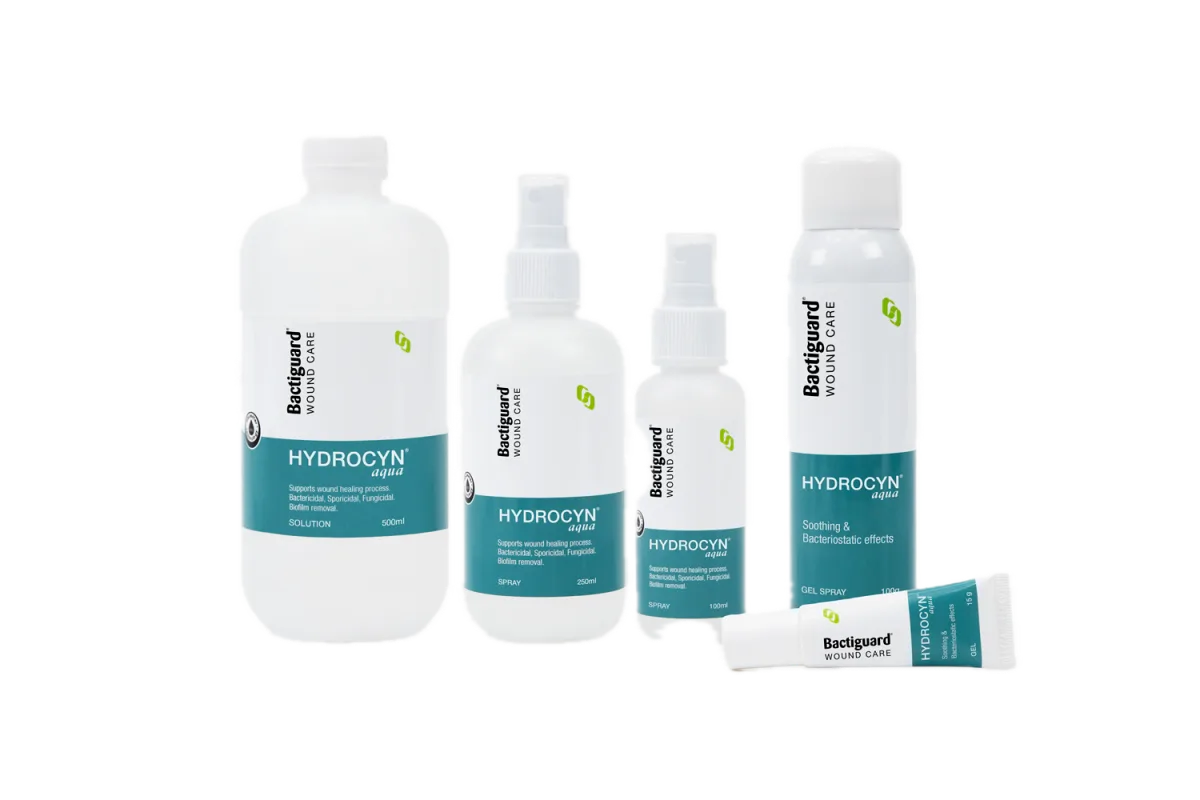
- Brand
- Bactiguard
- Stage
- 01 · Assessment and cleansing
- Size options
- 13
- Origin
- Sweden
What is it?
A sterile, biocompatible super-oxidized solution containing HOCl (hypochlorous acid), CE Class III certified, used for intracavitary irrigation and wound cleansing.
What is it made of?
HYDROCYN aqua is an isotonic, biocompatible, sterile super-oxidized irrigation solution produced by an electrochemical process, with hypochlorous acid (HOCl) as its active ingredient; it contains no alcohol, iodine, chlorhexidine or tissue-toxic carrier. Thanks to its near-neutral pH and low free chlorine concentration, it is applied for irrigation of the wound surface and intracavitary areas without harming viable tissue. The solution is delivered directly into the wound bed or surgical cavity to remove necrotic debris, biofilm and bioburden; the fluid and detached tissue are managed with a suitable absorbent secondary dressing. Application can be repeated according to clinical need and sits at the cleansing step of the wound care protocol (irrigation before/after debridement).
Why use it?
The assessments and comparisons in this section are the manufacturer’s own statements. Use of the product in a patient requires assessment by a physician.
On contact with the wound bed, HYDROCYN aqua creates a near-neutral yet biologically active environment that helps reduce the microbial load; this contributes to balancing the alkaline pH often seen in chronic wounds, creating a healing environment more favorable to cellular activity. The irrigation effect mechanically removes necrotic debris, fibrin and biofilm, increasing the effectiveness of autolytic debridement and making it easier to achieve a clean wound bed while preserving viable tissue. The absorbent secondary dressing used after applying the solution absorbs the removed fluid, microbial load and sloughed tissue, providing exudate control; this combination contributes both to reducing the risk of infection and to limiting mechanical trauma and pain during dressing changes.
HYDROCYN aqua’s active ingredient, HOCl, causes multi-target oxidative damage to the cell wall, membrane lipids and enzymatic proteins of microorganisms, contributing to rapid microbial inactivation; this multi-target principle differs from the single-target mechanisms of conventional antibiotics, so the development of lasting, selection-driven resistance is expected to be lower, although protective adaptation mechanisms against HOCl stress have been described in bacteria (2, 3).
With regard to biofilm, it has been shown that HOCl can suppress early biofilm formation in particular and can significantly reduce biofilm burden in some in vitro models; however, there are also studies reporting that its efficacy may decrease in complex biofilm environments depending on protein load and organic material (1, 4).
Compared with conventional antiseptics, it has been reported that the antimicrobial efficacy of agents such as povidone-iodine can be linked to cytotoxicity, whereas HOCl-containing solutions can show a lower cytotoxicity profile while suppressing biofilm in some cell culture studies; this may offer a clinical advantage in terms of tissue compatibility in irrigation and wound cleansing (1, 5).
Taken together, these properties position HOCl-based irrigation solutions as a rational option at the wound cleansing step, owing to their rapid microbial action, their contribution to biofilm control and their relatively gentler profile toward viable tissue (1, 5).
Irrigation of acute and chronic wounds, diabetic foot ulcers, pressure ulcers, venous and arterial leg ulcers, traumatic wounds, surgical wounds, burns, cavity wounds, conditions requiring intracavitary irrigation, and wounds requiring bioburden and biofilm control.
How to use
- 01
Assess the wound
Clinically assess the wound type and depth, the amount of exudate, bioburden and the presence of a cavity.
- 02
Prepare the wound
If necessary, gently remove loose necrotic tissue; clear gross debris before applying HYDROCYN aqua.
- 03
Irrigate
Apply a sufficient volume of HYDROCYN aqua directly to the wound surface or into the cavity to remove biofilm, fibrin, necrotic particles and microbial load.
- 04
Repeat if necessary
In the presence of heavy contamination or bioburden, irrigation can be repeated according to clinical need.
- 05
Apply a secondary dressing
Manage the removed fluid and debris with a suitable absorbent secondary dressing; compression or additional fixation can be applied where needed.
- 06
Follow-up
Application frequency is determined by the condition of the wound and the clinical protocol; irrigation can be repeated at each dressing change.
Catalog
The manufacturer’s catalog table, all 13 rows. For stock and supply status, contact us.
| Catalog no. | Product | Size |
|---|---|---|
| HW3CE700 | HYDROCYN aqua® Spray | 100 ml |
| HW34E100 | HYDROCYN aqua® Cap | 250 ml |
| HW34E700 | HYDROCYN aqua® Spray | 250 ml |
| HW35D100 | HYDROCYN aqua® Cap | 500 ml |
| HW36D100 | HYDROCYN aqua® Cap | 1000 ml |
| HW35C102 | HYDROCYN aqua® Irrigation Bag | 500 ml |
| HW36C102 | HYDROCYN aqua® Irrigation Bag | 1000 ml |
| HW40F900 | HYDROCYN aqua® Gel Tube | 15 g |
| HW41F900 | HYDROCYN aqua® Gel Tube | 30 g |
| HW42C900 | HYDROCYN aqua® Gel Tube | 50 g |
| HW4CB900 | HYDROCYN aqua® Gel Tube | 100 g |
| HW42E800 | HYDROCYN aqua® Gel Spray | 50 g |
| HW4CG800 | HYDROCYN aqua® Gel Spray | 100 g |
References
- Ortega-Peña, S., Hidalgo-González, C., Robson, M. C., & Kratz, G. (2017). Comparison of the microbicidal, anti-biofilm and cytotoxic effects of different antiseptic solutions. Cited in the Wounds International Made Easy summary.
- Crompton, M. E., et al. (2023). Expression of RcrB confers resistance to hypochlorous acid in uropathogenic Escherichia coli. Journal of Bacteriology.
- da Cruz Nizer, W. S., et al. (2020). Responses of Gram-Negative Bacteria to Hypochlorous Acid. Microorganisms, 8(8), 1220.
- Rembe, J.-D., et al. (2020). Antimicrobial hypochlorous wound irrigation solutions demonstrate lower anti-biofilm efficacy against bacterial biofilm in a complex in vitro human plasma biofilm model. Frontiers in Microbiology, 11, 564513.
- World Health Organization. (2025). Hypochlorous Acid (HOCl) – Expert Committee dossier (includes references to irrigation comparisons with povidone-iodine).
Samples or documents
for HYDROCYN aqua
Send us your requests for samples, application training, instructions for use or the full size list.